
How to Save for a Wedding in Canada (2026)
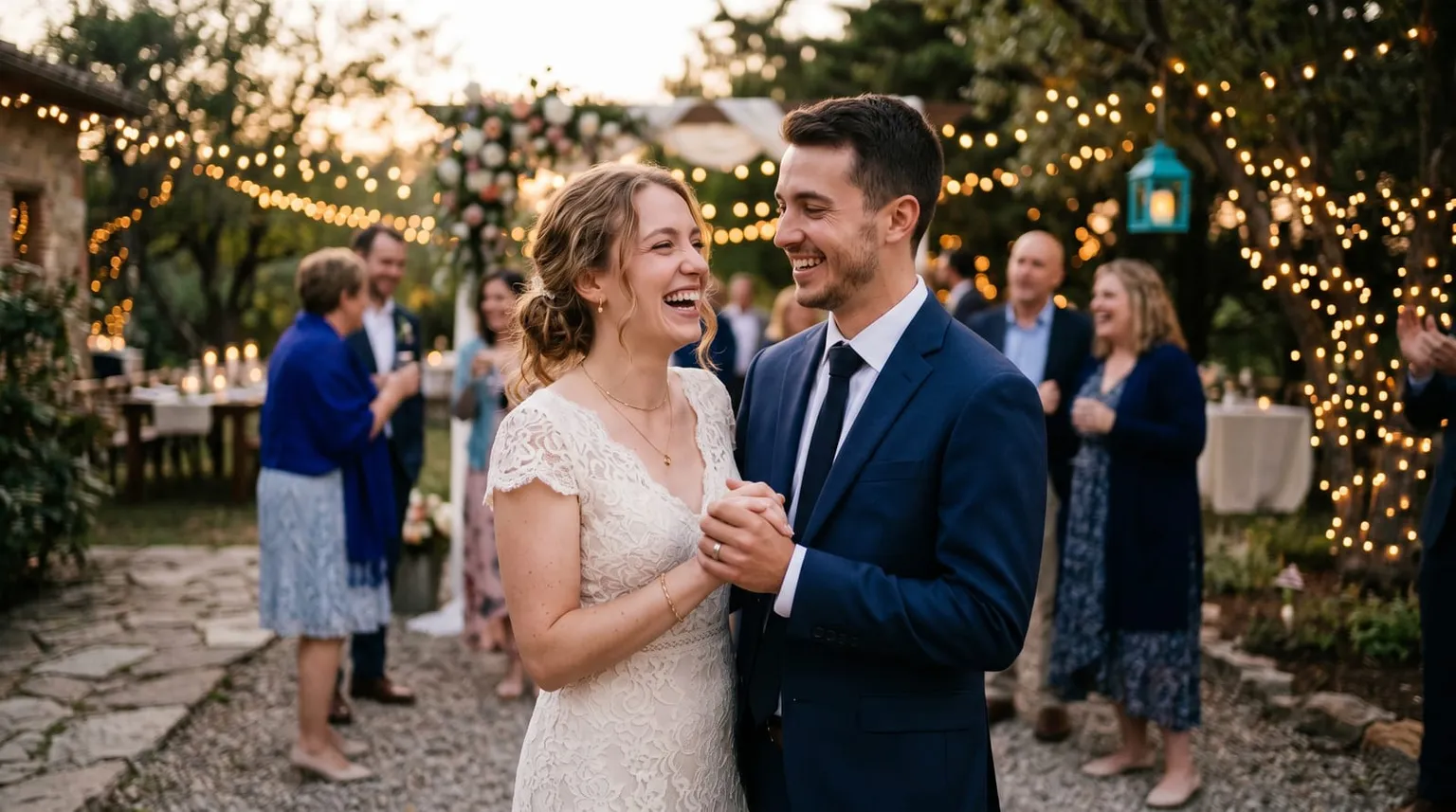
You’re engaged, you have a rough date in mind, and now there’s a number to figure out. The average wedding in Canada runs about $30,000 (WeddingWire pegs it near $29,450 on roughly 154 guests), though where you land depends mostly on your guest list and your city, anywhere from around $20,000 for an intimate day to $40,000 and up in a big-city venue. The good news is that a wedding has a date, which makes it one of the easiest goals to plan for. Here’s a simple, honest way to save for a wedding: set your number, pick a timeline, keep the money in the right place, and automate it so it barely stings.
How much should you save for a wedding in Canada?
Budget about $30,000 for a typical Canadian wedding, though the honest range is wide. WeddingWire puts the national average near $29,450, and 2025 reporting from WeddingWire and The Knot (opens in a new tab) stretches it to $30,000 to $42,000 in pricier cities. Your guest count is the single biggest dial. Venue, catering, and rentals make up 40 to 50 percent of most budgets, and every one of those costs scales with how many people you invite. Cut the guest list and you cut the biggest number on the page.
Set your target
Your number is built from a few choices, and you control more of them than the average suggests. Start with the two that move the most money, then layer on the rest.
- Guest count. This is the lever. A 150-person wedding and a 60-person wedding can differ by tens of thousands of dollars, mostly through the venue and the per-plate catering cost.
- Your city and venue. A downtown Toronto or Vancouver venue costs far more than a community hall, a backyard, or an off-season Sunday.
- The must-haves. Photography and video usually run 10 to 15 percent of the budget, attire and beauty another 7 to 10, flowers and decor about 7 to 10. Decide what you actually care about and trim the rest.
- Who’s contributing. Many Canadian couples get help from family. You only need to save your share, so settle that conversation early.
- A buffer. Add 5 to 10 percent for the marriage licence, gratuities, and the surprises every wedding produces.
Worked example: a 100-guest wedding in a mid-size city might run about $15,000 for venue and catering, $4,000 for photography, $3,500 for attire and beauty, $3,000 for flowers and decor, $2,000 for entertainment, and a $2,500 buffer. That’s roughly $30,000. If your families chip in $10,000 between them, your savings target drops to $20,000. We’ll show the math for the full number, and it scales straight down for your share.
Pick a timeline (the savings math)
The average engagement in Canada runs about 14 to 15 months, so most couples have one to two years to save. The table below is simple division of a $30,000 wedding across a few timelines. It doesn’t count any interest you earn along the way (a small bonus on top) or any family contributions. It’s just what you’d set aside each month to get to $30,000.
| Wedding budget | Timeline | You save / month |
|---|---|---|
| $30,000 | 12 months | ~$2,500 |
| $30,000 | 18 months | ~$1,667 |
| $30,000 | 24 months | ~$1,250 |
| $30,000 | 36 months | ~$833 |
Two things make these numbers smaller than they look. First, a wedding is usually two people saving, so split the row in half: $1,667 a month over 18 months is about $833 each. Second, if your target is your share after family help, scale down with it. A $20,000 goal is about $1,111 a month over 18 months, and a $15,000 intimate wedding is about $833. Pick the row whose monthly number fits your budget without straining it, and if the closest date feels tight, a slightly longer engagement is a plan you’ll actually keep rather than a failure. Want a different number? Our savings goal calculator covers any target, timeline, or monthly budget.
Where should you keep the money?
Keep your wedding fund in a high-interest savings account (HISA) at your own bank, separate from your everyday chequing so you don’t drift into it. For a goal one to two years out, stay in cash and skip the markets. A downturn the month before the wedding is the one risk you can’t take with money you’ve already promised to a caterer. Everyday HISA rates in Canada run roughly 2.5 to 2.85 percent as of June 2026 (EQ Bank’s Personal account pays around 2.75 percent with a qualifying recurring deposit and is CDIC-insured, for example).
A TFSA or a short GIC can do better
A couple of options can help. A TFSA keeps the interest tax-free if you have contribution room, so more of what you earn stays yours instead of going to tax. And because a wedding has a fixed date, you can lock in a rate with a short GIC timed to mature just before the day, often a bit more than a regular savings account (EQ Bank’s one-year TFSA GIC is 3.30 percent as of June 2026), as long as you won’t need the cash before it matures. A few banks dangle promotional rates near 4.50 to 5.00 percent on new deposits, but those are promotional and reset lower after a few months, so only chase one if you’ll move the money when the rate drops. For a fuller breakdown of where to park short-term savings, see our roundup of the best savings apps in Canada.
The point is that the account holding your wedding fund is your own, at a real Canadian bank or credit union.
Automate it so the fund builds while you plan
The Canadian household saving rate was just 3.5 percent in the first quarter of 2026, the lowest since early 2024 (Statistics Canada (opens in a new tab)). The fix isn’t willpower, it’s automation. Pay yourselves first.
- Open a joint wedding account. One place for both your contributions, where you can both watch the total climb toward the day.
- Set an auto-transfer for payday. Move your share into the wedding fund the moment you’re paid, before it can drift into everyday spending.
- Split it across your pay cycle. Paid every two weeks? Roughly $417 a transfer covers your $833 share for the month.
- Funnel the wedding-season windfalls. Cash gifts at the engagement party and shower, a tax refund, or a work bonus can go straight into the fund.
Decide once, let the transfer run, and the fund grows while you get on with the seating chart.
How Lodavo makes saving for a wedding more fun
Saving for a wedding can feel like the least romantic part of getting married: a fixed date, a big number, and months of transfers to reach it. The fund grows in your own bank account, exactly as described above. Lodavo is Canada’s first prize-linked savings app, and it links read-only to your savings or chequing account through Plaid (opens in a new tab), which supports over 99 percent of deposit accounts in Canada.
Your tickets follow the fund: the more the two of you put away, the more chances you get in that week’s draw. You could win up to $10,000, and every week a guaranteed prize of at least $100 goes to a user. The interest on the money stays yours either way. You can check past results under winning numbers.
So the same $833 a month that gets each of you to a $30,000 wedding also earns tickets every week along the way. The wedding is the goal. The draws are what make the long save easier to keep up.
Terms and conditions apply. No purchase necessary (alternate method of entry available). Skill-testing question required. Open to legal residents of Canada who are the age of majority. Odds depend on the number of eligible entries received. Full rules and odds at our contest rules.
Frequently asked questions
How long does it take to save for a wedding?
How can we save for a wedding as a couple?
Does Lodavo hold my wedding fund or help pay for the wedding?
Canada’s first prize-linked savings app
The more you save, the more chances you get to win
Lodavo is free. Keep saving in the account you already use, and earn free tickets in every weekly draw.


 Scan to download