
Cash Stuffing in Canada: Does the Envelope Method Work?
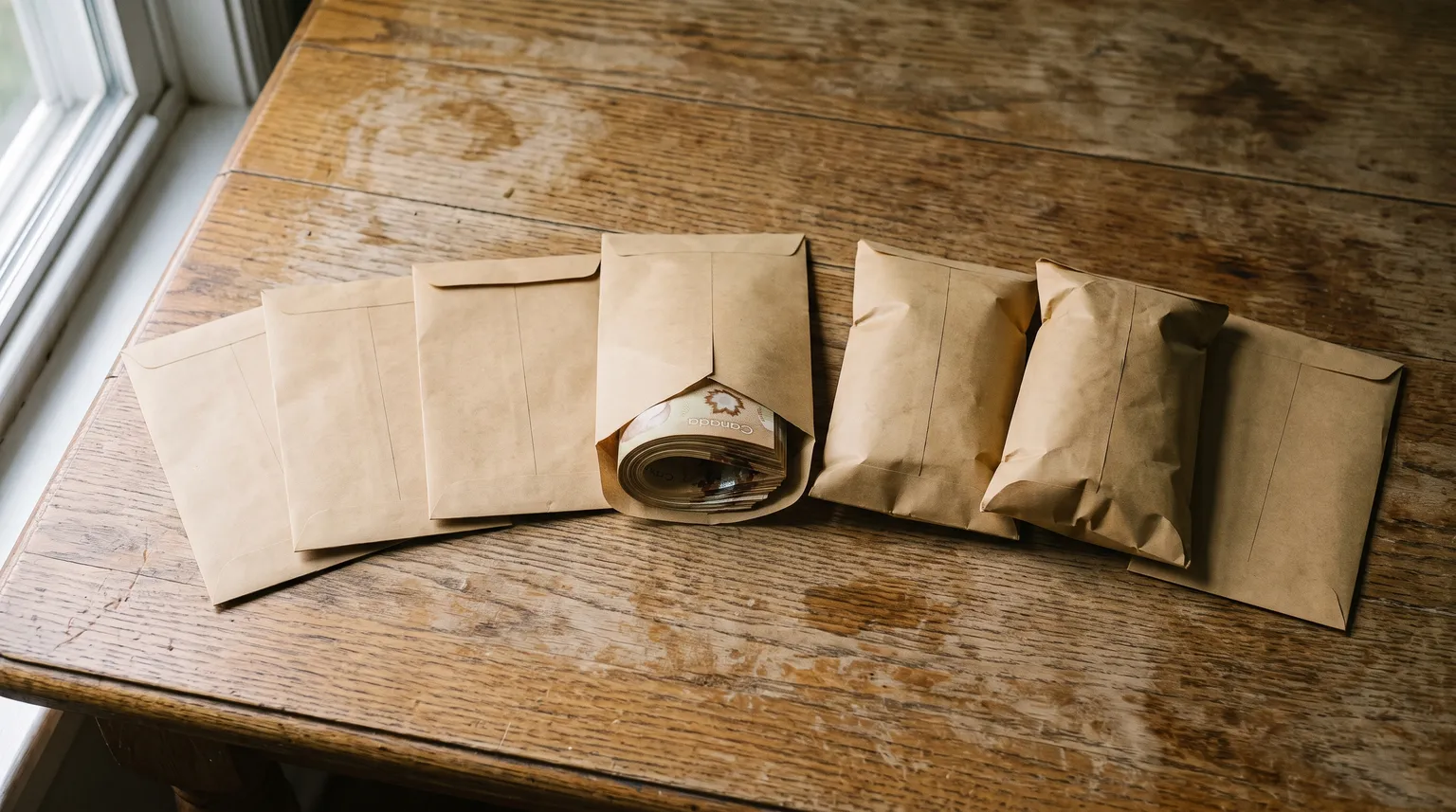
Cash stuffing is the envelope budget with a camera pointed at it. You withdraw your pay in cash, split it into labelled envelopes or a zippered binder, and when an envelope is empty, that category is finished for the month. The claim underneath it is that handing over bills hurts more than tapping a card, so you spend less. That claim is real. It’s also a lot smaller than the videos make it look, and in Canada a binder of cash carries costs worth knowing about before you start.
What is cash stuffing?
Cash stuffing is envelope budgeting rebuilt for social media. You decide what each category gets for the month, withdraw that much in cash, and divide it physically into labelled envelopes: groceries, gas, eating out, a sinking fund for car repairs. Spending stops when an envelope is empty, because there’s nothing left to hand over.
The method is much older than the trend. What’s new is the format, and it turns out to be very watchable: the counting, the labelling, the satisfying thud of a full binder. That’s a real part of the appeal, and it’s worth naming, because it’s also the part you can keep when you drop the cash.
What a month of it looks like
- Work out your take-home pay and your fixed bills first, since rent and insurance can’t be paid in twenties.
- Split what’s left into categories, and give each one a number.
- Withdraw that amount in cash, usually weekly or on payday.
- Fill the envelopes, spend only from them, and stop when one runs out.
That third step is the one that costs you money in Canada. More on that below.
Does cash stuffing actually work?
Partly. People do spend a little less when they pay with cash, and that’s been measured carefully rather than assumed. But the effect is small, it’s been shrinking for years, and it only applies to the moment of paying. The decisions you make before the money leaves the bank are doing most of the work.
What the biggest study of it found
The most thorough test is a 2024 meta-analysis in the Journal of Retailing (opens in a new tab) by researchers at the University of Adelaide and the University of Melbourne. They pooled 40 years of experiments: 392 separate measurements from 71 papers across 17 countries. The pooled result was small, positive and statistically significant, at 0.135 on the scale researchers use for this, where 0.2 is the threshold for calling an effect small at all.
Two of their other findings matter more for a household budget than the headline does. The gap was widest for status purchases, jewellery and the like, where people appear to reach for a card to soften an expensive moment. And it vanished for donations and tipping, where they found no discernible difference between cash and card.
Why the effect is fading
The same analysis found the cashless gap has been narrowing over time. The authors read that as familiarity: tapping used to feel abstract, and now it’s just how paying works, so the sting of cash and the ease of a card have moved closer together. If your whole plan rests on physical money feeling different, that’s a plan built on a shrinking margin.
None of which makes cash stuffing useless. It makes the paper the smaller half of it. The part that changes your month is deciding in advance what each category gets and then having a limit you can actually see, and neither of those needs a binder. Our guide to making a budget in Canada covers the same structure without the withdrawal.
What does a binder of cash cost you in Canada?
Four things: the interest it doesn’t earn, the purchasing power it loses to inflation, the coverage it doesn’t have if it’s stolen or burns, and the fees you may pay to pull it out of the bank each week. The insurance one surprises most people, and it’s the smallest number of the four.
| What it costs | Why | On $1,000 held for a year |
|---|---|---|
| Interest given up | Cash earns nothing. Online savings accounts paid 1.00% to 2.75% in mid-2026 | About $10 to $28 |
| Purchasing power | Prices rose 2.8% over the year to June 2026 | The bills buy about $973 worth |
| Coverage if it’s gone | Home and tenant policies cap cash separately from your other belongings | $200 to $500, not $1,000 |
| Getting it out | Weekly withdrawals can pass a chequing account’s free-transaction limit, and other banks’ machines charge extra | $0 to a few dollars a trip |
The first two rows describe the same gap from two sides, so don’t add them together.
Your cash is covered for $200 to $500
Home, condo and tenant policies pay up to your full contents limit for most of what you own, but a short list of items carries its own much lower cap. Cash is on that list. The Insurance Bureau of Canada’s consumer guide puts the limit for bank notes and cash (opens in a new tab) at $200. RBC Insurance (opens in a new tab) lists $500 for money, cash cards and bullion. The exact figure varies by insurer and you can often buy a higher limit, but the range is a couple of hundred dollars, not a couple of thousand.
That’s awkward for a method whose whole design is to hold a month of spending in one place. A break-in, a fire or a burst pipe takes the rest, and no claim brings it back. The same money in a chequing or savings account at a CDIC member is protected up to $100,000 per category, automatically and for free, which our guide to deposit insurance in Canada breaks down.
The interest, and what inflation does to the rest
A thousand dollars in an online savings account earns somewhere between about $10 and $28 over a year, depending on the account and whether you meet its conditions. EQ Bank (opens in a new tab) pays 1.00% on its Personal Account, rising to 2.75% once you route recurring direct deposits of at least $2,000 a month through it, as of June 2026. The same thousand in an envelope earns nothing at all. Prices rose 2.8% in the year to June 2026 (Statistics Canada (opens in a new tab)), so those bills buy roughly $973 worth of groceries twelve months later.
On one month of grocery money the difference is pocket change. On a sinking fund you’re building for two years, it isn’t.
How much cash do Canadians actually keep at home?
Less than the trend suggests, and far fewer people. The Bank of Canada’s 2024 Methods-of-Payment survey (opens in a new tab) found that only 22% of Canadians keep any cash outside their wallet, purse or pockets. Among those who do, the median stash was $200, which happens to land exactly on the insurance cap above.
Cash itself is doing fine. It was used for 21% of purchases in 2024 and 11% of what Canadians spent, third behind credit and debit, and 79% of people said they had no plans to go cashless. Cash is alive and well as a way to pay. What almost nobody does is use it to hold savings, and that’s exactly what a binder of envelopes is for.
How do you keep the discipline without the cash?
Give every category its own container that still earns interest. A named savings account is the closest digital match to an envelope: raiding it takes a deliberate transfer, and that pause is most of what the paper was providing. Set the split to happen automatically on payday and the decision stops being a weekly errand.
| Cash envelopes | Named savings accounts | One account, tracked in an app | |
|---|---|---|---|
| Friction before you spend | Highest | A transfer first | Lowest |
| Earns interest | No | Yes | Yes |
| Deposit insurance | None | Up to $100,000 per category | Up to $100,000 per category |
| Works for rent and online bills | No | Yes | Yes |
| Weekly effort | A trip to the bank | None once it’s automatic | None |
Three moves cover most of it:
- Open a second and third savings account and name them. Most online banks let you open several at no cost, and a labelled “Car” account behaves like a labelled envelope. Our roundup of high-interest savings accounts in Canada has the current rates.
- Move the money the day you’re paid, not at the end of the month, so it leaves before the rest of the paycheque is spent.
- Keep one real cash envelope for the single category you genuinely overspend on. A small one for eating out stays inside the insurance limit and gets you the friction exactly where you need it.
If the hard part is starting at all rather than choosing an account, that’s a different problem with a different fix, and why saving is so hard is the honest version of it.
The same weekly ritual, minus the paper
There’s one more thing a binder does that a spreadsheet doesn’t. It gives you something to look at every week. Filling the envelopes is the reward, and that weekly ritual is a big part of why people stick with it.
Lodavo is a free savings app built around that same weekly rhythm, minus the paper. Link the account your savings already sit in, and every $25 you keep there earns you a ticket in a weekly cash draw. Prizes run up to $10,000, and at least $100 goes to a user every week.
Your savings never leave your own account, which is where cash stuffing runs into trouble: the money keeps earning its rate, and it keeps its deposit insurance, while the draw gives you a reason to look forward to Sunday.
Start with the category that gets away from you
If cash stuffing appeals, the useful part is the decision, not the withdrawal. Pick the one category where the month always slips, give it a number, and move that number somewhere separate before the rest of the paycheque goes anywhere. Then check on it weekly, because the checking in is what makes it stick.
Want saving to feel like something worth doing? Download Lodavo free on the Apple App Store (opens in a new tab) or Google Play Store (opens in a new tab) and start earning tickets for the weekly draw.
Terms and conditions apply. No purchase necessary (alternate method of entry available). Skill-testing question required. Open to legal residents of Canada who are the age of majority. Odds depend on the number of eligible entries received. Full rules and odds at our contest rules.
Frequently asked questions
Can I do cash stuffing if most of my bills come out automatically?
Is a sinking fund the same as a cash envelope?
Will paying cash for everything affect my credit score?
I already have cash stuffed away. What should I do with it?
Canada’s first prize-linked savings app
The more you save, the more chances you get to win
Lodavo is free. Keep saving in the account you already use, and earn free tickets in every weekly draw.


 Scan to download